In Frankfurt, we combined hardware discoveries, short driving sessions and a closer look at a complete cockpit. Active pedals and motion systems were central to our visit, with one recurring question: how do we get useful feedback rather than simply pile on effects?
First impressions: Cube Controls, VPG and Simagic
At Cube Controls, the Vega surprises us with its low weight. The Phoenix retains a familiar grip and well-finished paddles, although we find its button travel rather long. The displayed cockpit remains a concept: titanium details, a single-seater-style position, an integrated monitor mount and a VNM base. It should not be confused with a finished production package.
The VPG Porsche wheels appeal to us visually, but their sticky grips and unusual shape are less convincing. The buttons are firm and the first wheel’s paddles are particularly loud. We almost prefer the Cup version, whose paddles have shorter travel. Encoder lighting also looks less even on one of the samples.
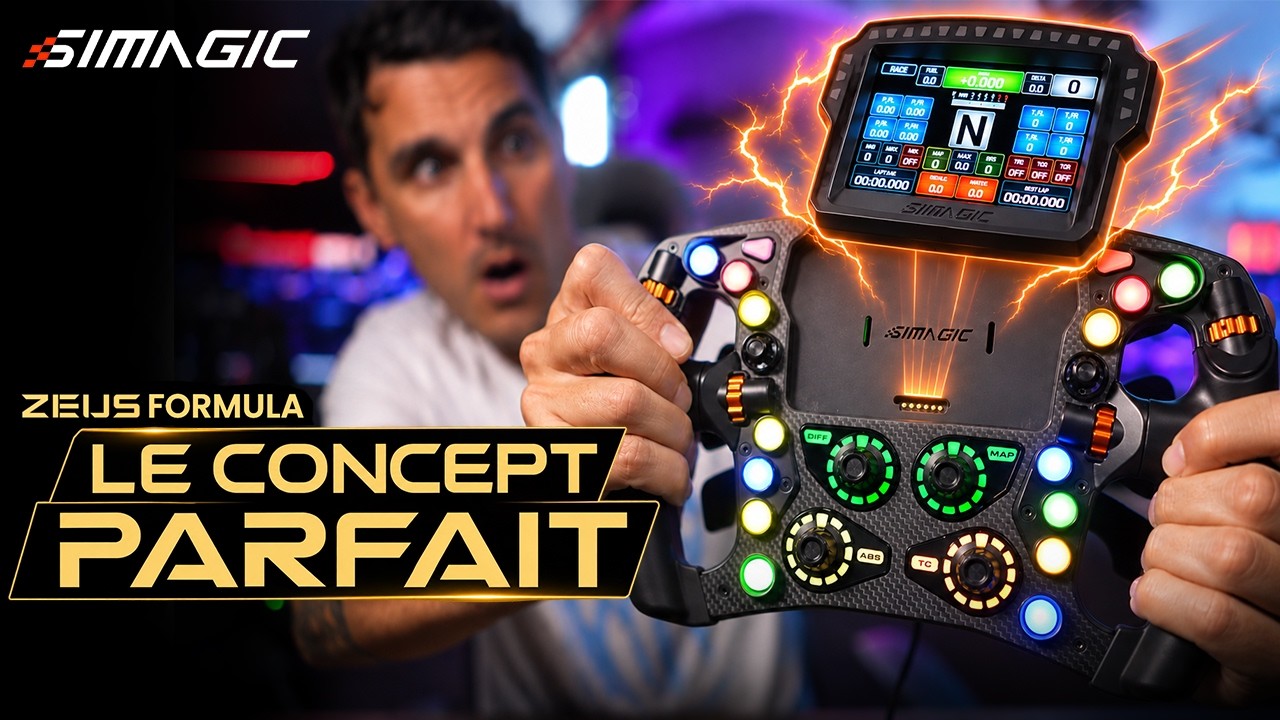
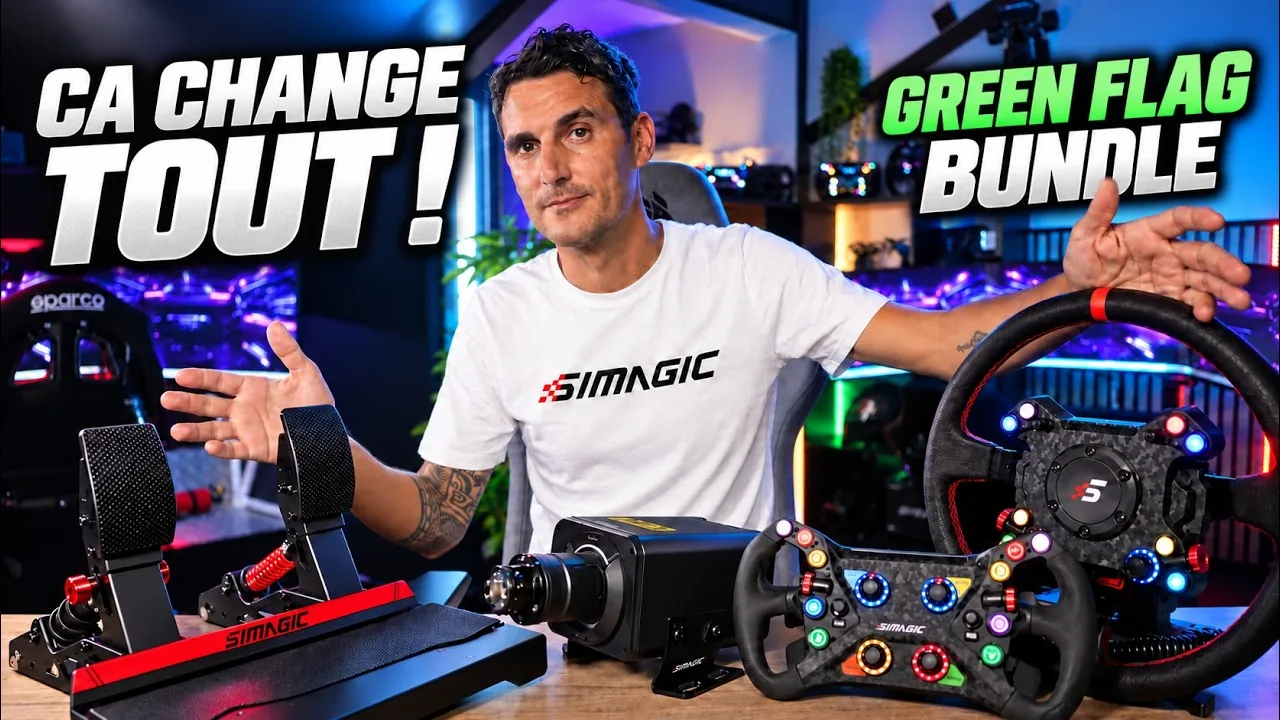
At Simagic, the KTM has soft Alcantara grips, while the Valkyrie stands out primarily for its height. Its ergonomics and covering do not immediately suit our preferences. The active pedal attracts more of our attention: its motor drives a linear rail through a belt in a particularly compact assembly. At this point, some mechanical adjustments and connection details remain unclear.
Wheels, displays and integration
We appreciate the short paddle travel on the Heusinkveld wheel. Fanatec’s dashboard stands out for its large screen, pleasing definition and glossy surface. On some Zen’s Simwheels models, certain controls appear harder to reach.
The Simrig belt tensioner has an interesting pulley arrangement, although we do not try it immediately. At GSI, the Artemis impresses us with its grips, crisp buttons and very short, firm paddles; the Interlock Ultra incorporates an LED matrix into the rim. Recaro’s cockpit prioritises a neatly integrated appearance, but its modularity seems limited. We cannot confirm all its adjustment options from the display alone.
MOZA: announcements and first laps with the HMA150
MOZA presents Mercedes-Benz, Ford and Porsche licensed wheels, a MotoGP handlebar and a pedal haptic module. Its announced PlayStation compatibility relies on electronics inside the wheelbase, with peripherals connected through that base. These are the manufacturer’s explanations, not a comprehensive compatibility check on our part.
Our driving session combines an R21, a Mission R wheel and HMA150 actuators. Steering feels smooth and the small vibrations are pleasant. However, the base is set fairly lightly, motion remains restrained and the mBooster brake is too stiff for our taste. This configuration therefore does not let us explore the motion system’s limits.
Integrating the drivers into the actuators makes the installation compact. A separate rally demonstration uses much stronger movements. MOZA also demonstrates motion generation for games without native telemetry: this remains a demonstration rather than something we have evaluated thoroughly.
PXN, ImSim and Conspit
PXN is expanding its range with bases announced at 16 and 23 Nm, prototype Formula wheels with screens and a truck wheel. The company describes USB connectivity for use with other bases through a suitable mounting system, plus customisation through its own software or SimHub. Its flight-simulation ecosystem also includes throttles, a joystick and rudder pedals.
The S16 we drive feels reasonably precise, with noticeable road feedback. Its low force setting prevents a proper assessment of dynamic range. A slight grinding sensation remains unexplained: we cannot attribute it to cogging. The GT1 is comfortable enough to hold, but its paddles resonate and its grips offer little cushioning.
After the ImSim Porsche cockpit, recognisable in particular by its rear lights, we move to Conspit. The 280 brings softer grips and push-pull paddles. The 300 GT supports SimHub, which we have already tried, although dashboard sizing still requires attention; the native displays remain convincing. The company also shows a combined H-pattern and sequential shifter, alongside a compact hydraulic handbrake.
Simucube 3 Pro and ActivePedal Sport
Driving a McLaren 720 at Spa in iRacing, we quickly feel comfortable with the Simucube setup. The base, confirmed after the session as a 3 Pro, combines strength with subtlety. The brake is configured with 35 mm of travel, while the Co-Pedal used as the throttle feels firm but pleasant.
The ActivePedal Sport delivers particularly clear ABS feedback. The graininess felt earlier while stationary disappears when driving: we find a smoothness close to our experience with the ActivePedal Pro. At a comparable budget, we would favour the Sport over the mBooster here, while accounting for the required accessories and differences in total configuration cost.
This remains a show-floor impression. We did not change the base settings; some load-transfer and road effects would have benefited from adjustment. A vibration with the engine stopped also reminds us that telemetry effects can become unnecessary additions.
Motorcycles, Asetek ABS and Simagic adjustments
The motorcycle simulator we try at Trak Racer takes some learning: the relationship between body movement and steering is unfamiliar. Without powered force feedback or wheelie movement, it remains entertaining but does not reproduce every natural motorcycle motion. Its controller sends joystick-style inputs and is configured through a SimHub plugin.
We also try an Asetek ABS module that is not shown on camera. Its effect feels considerably more convincing than simple haptic motors, although this is only an initial impression of a device presented as being in development.
At Simagic, the active pedals initially feel too stiff, with excessive throttle vibration. We ask for fewer telemetry effects to isolate the ABS more clearly. After adjustment, the throttle responds cleanly and we do not notice significant graininess.
Our assessment of the brake remains more cautious: our foot is poorly positioned, ABS feedback stays light and an engine-speed effect makes it harder to interpret. We cannot confirm a possible delay in activation. The interface shown uses percentages; we did not understand its travel management well enough to compare it precisely with the millimetre-based adjustments available elsewhere.
HB Vortex and Naga’s cockpit
HB Vortex presents motion packages integrated into several cockpits. The manufacturer describes telemetry processing through a virtual-car model, a Wi-Fi connection using UDP packets and electronics housed beneath the seat. Its compatibility and support statements remain manufacturer information: we do not conduct a detailed driving test.
Naga’s cockpit combines a Sim-Lab P1X, Simrig SR3 actuators, a Simrig belt tensioner, a Simucube 2 Pro, two active pedals and a Sim-Lab Porsche Cup wheel. Power supplies and USB hubs are grouped and labelled beneath the chassis to simplify moving the rig and troubleshooting. The belt pulleys allow the straps’ routing to suit the reclined seating position.
Before driving, we adjust our position and launch belt calibration through a button linked to the software. Pressure can then be reduced through a dedicated control. In Le Mans Ultimate, the harness adds noticeable tension under braking, during gear changes and through corners. Together with the actuators and Buttkicker, these cues complement each other without requiring exaggerated movement.
Takeaways from the weekend
### What we liked - The ActivePedal Sport’s clear ABS feedback and the refinement of the Simucube setup we tried. - The combination of harness tension, motion and vibration in Naga’s cockpit. - Centralised controls and compact integration that make the equipment easier to use.
### What we liked less - Demonstration settings that were sometimes too stiff or overloaded with effects. - Our imperfect driving position during the Simagic session, which limits our conclusions. - The very wide field of view and particularly light steering in the final cockpit, which we would adjust to our preferences.
The main lesson is not to turn everything up. A correct driving position, identifiable feedback and suitable intensity matter more than a spectacular demonstration. These short sessions provide useful reference points, but they cannot replace comparisons using equivalent settings.
Join the discussion on YouTube