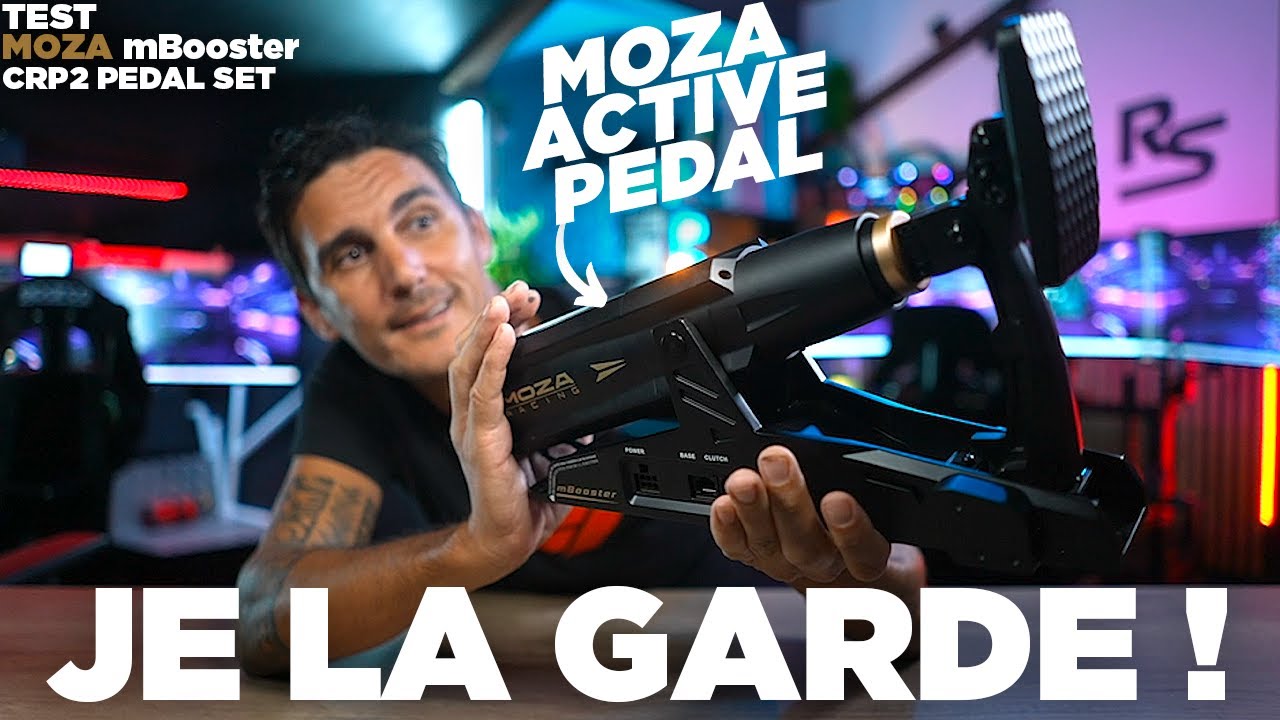
This video revisits the MOZA mBooster after several firmware and Pit House updates. The change I had been waiting for is ABS feedback in Le Mans Ultimate. I test it in a Porsche GT3, then revisit travel, force and effect settings. The aim is clear information underfoot, without adding vibrations simply because the options are available.
ABS now works in LMU
The effect is visible immediately after leaving the pits: the pedal reproduces ABS intervention under braking. It was missing during my initial product tests, while other active solutions already offered it in this game. The update therefore addresses a practical gap.
Pit House provides separate frequency, intensity and smoothing adjustments. A higher frequency produces faster oscillations; a lower frequency gives a different sensation. I demonstrate a 25 Hz setting with an intensity I still find slightly strong. It is not a preset to copy blindly: I want a signal that remains easy to identify while braking.
Physical travel and the game input
Starting position and end of travel are still adjustable in software. In the demonstrated version, the available range remains limited even when the starting point is moved. Changing pedal position therefore does not mean its entire travel can be lengthened without restriction.
Simulator input mapping determines the signal sent to the game. At this point I am using the load cell and feel that ABS feedback is more clearly defined in that configuration. I distinguish this choice from the mechanical response underfoot: changing the sensation does not replace brake-input calibration.
Preload, damping and curve shape
The new segmented damping function changes movement resistance across different parts of the travel. Preload adds an initial effort before the pedal starts moving. During the demonstration I try several values to understand their interaction rather than settle on a universal final configuration.
I generally prefer a fairly linear progression. Some strongly shaped curves feel artificial to me and make the end of braking too hard. A curve can still provide a useful reference underfoot, but I check its effect while driving rather than judge its appearance on screen.
I also dislike braking against a wall. In the configuration shown, I would have liked to reduce the force slightly further. Saving profiles allows me to preserve a comfortable result before experimenting again.
Selecting effects for a purpose
I mainly associate engine vibration and traction-control feedback with throttle use. My bass shaker already provides gearshift information, so I do not need to duplicate it in the brake. I also leave out some slip effects that I prefer to interpret through the wheel.
Road textures can add subtle vibration, but they can also obscure the pedal’s main message. Wheel-lock indications and threshold-triggered vibrations should not be confused with actual ABS intervention reported by the game.
Trying the G-force effect
Finally, I test the effect that moves the pedal slightly according to acceleration. The motion feels smooth and interesting for immersion. I mainly notice it when my foot is not loading the brake; during braking, repositioning is less apparent.
The motion actuators are not active in this sequence. Combining the effect with a motion platform or harness is therefore a possibility to explore, not a result demonstrated here. For my immediate use, the most useful improvement remains ABS in LMU with restrained, clearly differentiated settings.
Join the discussion on YouTube