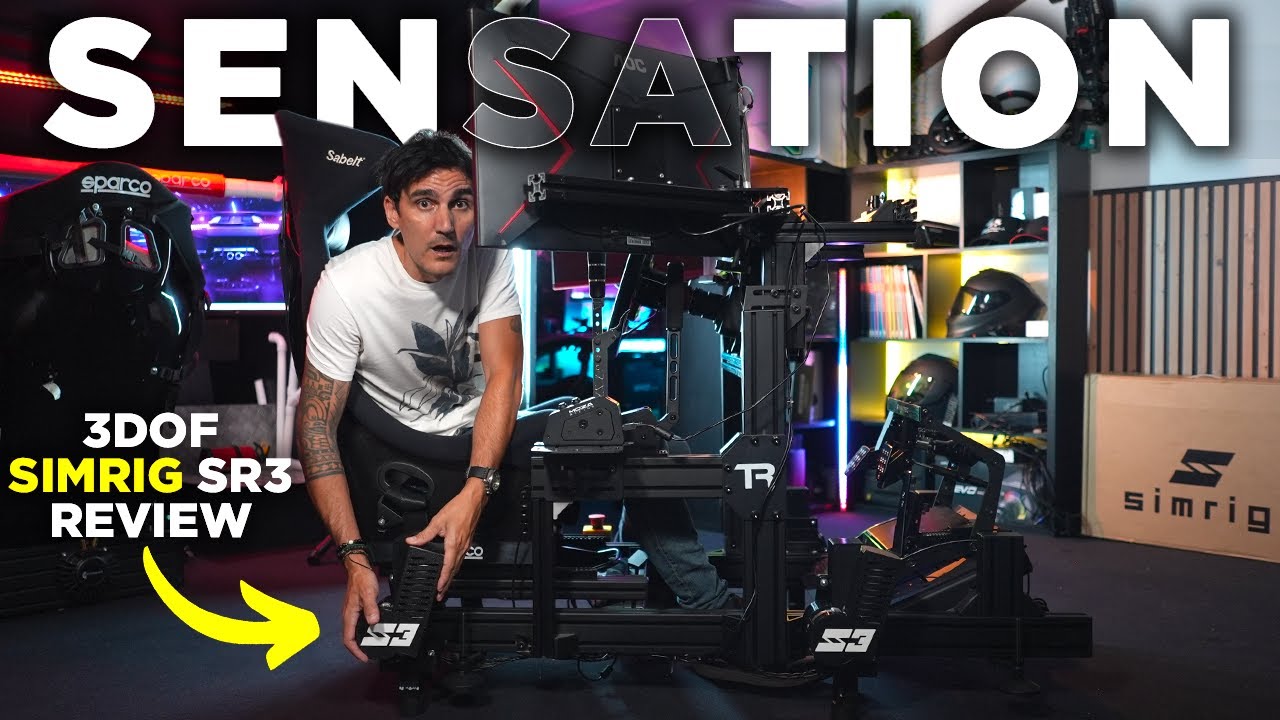
In early 2024, I am looking to replace my Sim-Lab GT1 Evo and reviewing what I expect from a chassis. The choice is about more than profile size or the advertised price. Moving from a desk to an aluminium cockpit has mainly taught me to examine the mounts carrying the loads, driving-position adjustments and the cost of a complete setup ready to use.
Rigidity and the evolution of my setup
A chassis’s first job is to hold the wheel and pedals in a fixed relationship to the seat. Noticeable flex disrupts my reference points and immersion. I therefore want rigidity, particularly around the wheelbase and pedal mounts where I apply force.
I began at a desk, then used a second-hand Playseat Formula before moving to profiles. I initially integrated the screens into the cockpit, then separated their stand. These changes accompanied the move to a load-cell brake and Direct Drive. The chassis needs to follow those developments with height and distance adjustments and attachment points for accessories.
Profile size does not tell the whole story
Designations such as 40 × 40, 80 × 40, 120 or 160 describe profile dimensions. They indicate the structure, but do not replace examining the connections. A robust frame can still have a wheel mount that moves.
That is precisely my criticism of the GT1 Evo I use: the wheelbase support drives my wish to change. Adding front or side mounting may meet a need, but requires another order, more parts and delivery charges. I prefer to consider the right mounting arrangement from the start.
Considering a self-assembled chassis
I also look at Motedis profile solutions. They allow budget control and cockpit customisation. You still need to check what is included: seat brackets, wheelbase inclination and pedal-deck construction.
A fixed wheelbase plate may suit a wheel with an already angled housing but require another support when moving to Direct Drive. Resale value also enters my thinking: a personal build can work very well without being as easy to identify as a recognised model.
A separate screen stand
For my triple screens, I prefer a structure independent of the cockpit. My experience with integrated supports involved more restrictive adjustments. On a personal build, I also consider where larger profiles are really useful rather than oversizing every part.
I favour Vario VESA mounts for fine monitor adjustment and Xero Play pivots for the arm angles. The aim is easier alignment, even if these accessories increase the initial budget. Grouping purchases can also limit delivery costs.
Comparing complete cockpits
In my research at the time, the Trak Racer TR80 Lite looks interesting with its seat and shifter brackets. The lack of a heel rest still needs consideration alongside the chosen pedals. Delivery to Réunion made this route much less attractive for me.
I also consider the Sim-Lab GT1 Pro, Next Level Racing models and the RSeat range. Angled uprights do not suit my installation: they can restrict seat access or screen positioning between the wheel and base. This is a personal layout criterion rather than an automatic fault for every user.
The prices and stock information shown belong to early 2024. My main takeaway is to compare a total including the seat, sliders, brackets, any heel rest and transport. A lower starting price can lose its advantage once these items are added.
My priorities
I therefore prioritise rigid supports, an adaptable position and room for future accessories. For the seat, my Sparco without head wings has served me well for several years. I prefer to choose something that suits my body and installation rather than treating the seat as merely an aesthetic addition.
Join the discussion on YouTube