After the Cammus C5, I move to the C12, which keeps the motor integrated behind the wheel while adding torque and controls. It remains compact, with a quoted price of around €600 in this test. I am interested both in the force feedback and the compromises of the package: installation, cooling, control quality and the possibilities for changing wheels later.
Installing a compact package
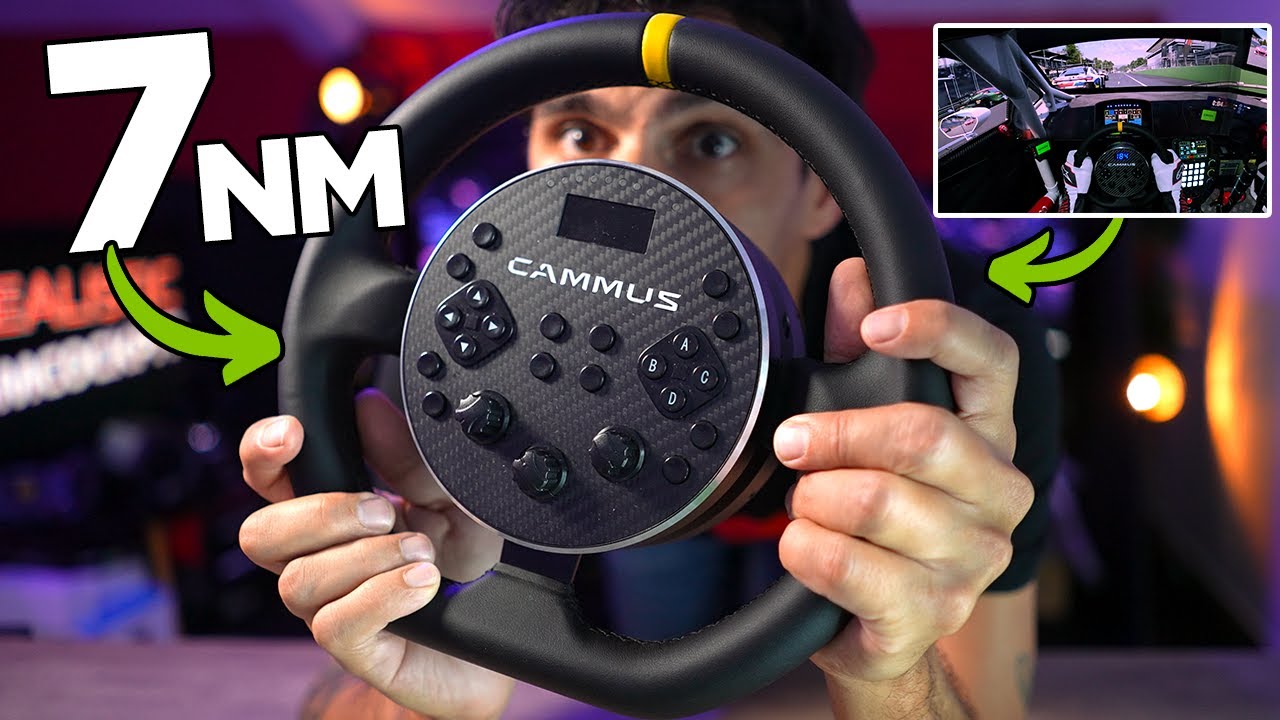
The C12 combines a 30 cm rim, its control panel and a Direct Drive base rated at 12 Nm sustained torque. There are no pedals in the box. It includes mounting brackets, hardware, the PC cable, a 350 W power supply and a fan. The tilting desk mount shared with the C5 is sold separately; this is also where the fan is intended to mount.
The supplied brackets use spacing found on MOZA- or Simagic-compatible supports. Installation on a cockpit is therefore fairly conventional despite the unusual shape. Power uses an XT60 connector, which works but is not especially refined in presentation.
The package works on PC. Its Cammus accessory ports do not prevent using another brand’s pedals connected to the computer by USB. The small footprint can help bring screens closer or make the hardware easier to transport, provided you also account for the PC and pedals.
A replaceable rim, with limited upgrade options
The rim unscrews from the hub using a 6 × 70 mm pattern. I was able to fit a Fanatec Porsche rim, for example. The stock 30 cm diameter suits me better than the C5’s 28 cm, but I would still prefer something larger and less narrow. The imitation-leather covering is fairly ordinary.
Replacing the rim should not be confused with a quick-release system. The hub remains attached to the base: you cannot replace the entire control assembly with a Formula wheel as you can with a separate base. The lack of analogue paddles is therefore more restrictive, since you cannot simply add another wheel equipped for clutch control.
Controls, display and paddles
The carbon front looks good. Ten backlit buttons, rotary controls and directional switches allow plenty of functions to be assigned. Colours are customisable, but the buttons already carry labels; I generally prefer to choose those myself.
The buttons have fairly long travel and are noisy. The rotaries mix materials, and some turn very easily, so accidental adjustments are worth watching for. The small magnetic carbon paddles are larger than the C5’s and have a firm click. They remain modest in size, but their position works correctly with the original rim.
The three-digit display shows speed or the selected gear. The rev strip and indicator lights provide the expected information, although the individual LEDs are very visible and the finish is not particularly polished.
Temperature and force reserve
The power is clearly noticeable and provides headroom when several demands build together. You do not need to drive at maximum force constantly to benefit from that reserve.
The base does heat up fairly quickly, however. Thermal management slightly reduces force to limit temperature. The fan helps cooling, but I find it very noisy. This is a practical compromise if quiet operation matters to you. The peak-torque estimates mentioned aloud are not measurements performed during this test.
Settings in the Cammus software
I begin by checking for updates, centring the wheel and choosing the rotation angle. The software also controls brightness, button colours, speed display and the rev strip. Some controls appear in several tabs, making the organisation a little confusing.
Force-feedback settings include damping, friction, inertia and a spring effect. I tend to reduce added effects so the game can provide the feedback, then adjust gain in the simulation. The filter can soften some grainy sensations; I seek a balance that preserves bumps and kerbs. Force-feedback inversion is available too.
End-stop strength is separate. On its firm setting, it clearly blocks rotation at the selected angle, which I appreciate as a definite steering limit. The software also offers protection when the driver’s hands leave the wheel.
Driving feel and overall impressions
I do not feel bothersome cogging in game and encountered no oscillations during my tests. Force feedback is coherent and pleasant, with friction that can be reduced in the settings. Beyond the torque figure, that is the C12’s main strength.
I am less convinced for someone who wants to keep expanding their setup. A separate base and wheels require comparing the complete budget, but provide more choice. The C12’s main appeal remains its powerful, compact package.
What we liked
- Smooth, powerful and stable force feedback during the test.
- The compact format and numerous controls.
- A replaceable rim and firm software end stop.
What we liked less
- Fan noise and the heat-related reduction in force.
- No analogue paddles or quick hub changes.
- Uneven finish across controls and lighting.