I recorded this account on 28 February 2024, one week after Le Mans Ultimate entered early access. It covers a frustrating start with bugs, alongside races that made me want to come back. These impressions describe that initial release: the stability issues, missing features and settings discussed here belong to the game's launch period, rather than its present-day state.
One race changes the picture
My opening hours were difficult. I had to investigate peripheral support, SimHub and triple-screen setup, then reinstall the game and clear its files before I could access multiplayer. I cannot attribute that failure to one particular change: this is simply what happened on my computer.
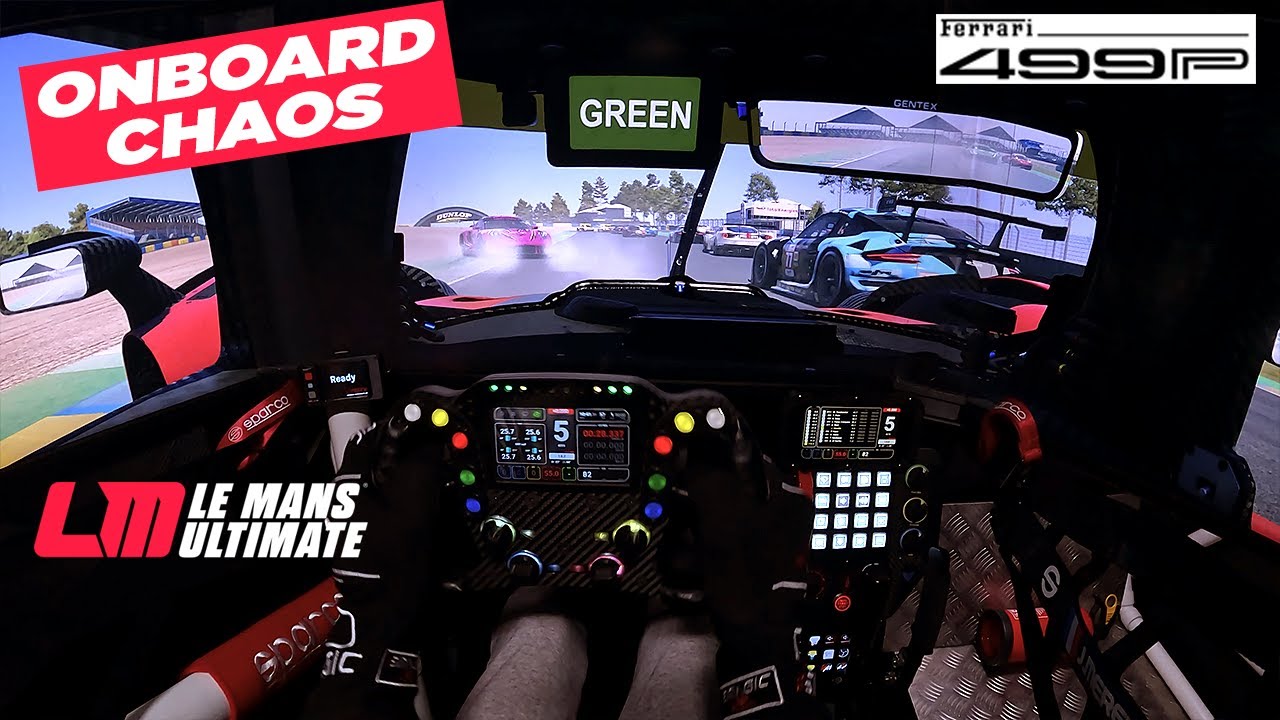
Once on track, things felt different. The “Le Mans 2.4” event, which I entered in a GTE, made a particular impression. Accelerated time takes the race through sunset, darkness and dawn, while multiclass traffic keeps demanding attention. I finished second, after a race in which the interactions between classes felt clean and respectful. That experience explains why I remained enthusiastic despite the difficult start.
Driving and force feedback make me want another lap
I recognise rFactor 2's influence in the detailed force feedback and demanding handling. The GTEs, LMP2s and Hypercars require precision: mistakes quickly become costly. That is rewarding when learning the car, but it assumes some existing driving experience.
On my Simagic Alpha Mini, I ended up adjusting strength in the base software, at around 60%, because the car-specific setting would not stay saved during my tests. This was a response to a problem in that release, rather than a universal profile for every wheelbase.
Another useful distinction is to reduce collision and kerb effects separately, here to 60, instead of weakening all the force feedback to tame their jolts. This lets me retain more steering information. The aim is to understand the car's behaviour without allowing the harshest effects to dictate overall strength.
A convincing endurance atmosphere
I really like the car models, official liveries and engine sounds. The circuits have distinct identities, and the day-to-night transition gives the race a sense of place. Multiclass racing also works in single player, allowing endurance traffic to be explored before entering an online event.
The AI creates lively situations, including mistakes and occasional accidents. Flags and light panels make those incidents visible around the circuit. However, I wanted more spoken information. During my race, I would have liked better updates on nearby rivals' stops and strategy. That describes what I heard with my settings, rather than an exhaustive assessment of every audio option.
This presentation also demands computing power. My i9, RTX 3070 Ti and three 1440p screens were already close to the limits of my system. Lowering options helps manage the workload, but I found the visual compromise less convincing than the higher-settings presentation.
Multiplayer is there, but the learning curve is steep
Daily races and scheduled events, with driver and safety ratings, were available from launch. That matters to the game's appeal, because the single-player experience I tried centred on individual races, without a career to guide progression.
The standard of driving online was already high. Anyone learning simracing, PC settings and new equipment at the same time could find this a demanding introduction. At that point, I would have suggested building experience with slower cars and a beginner progression before tackling this endurance field. That is an observation about accessibility, rather than the enjoyment available to an experienced simracer.
The obstacles in that opening week
I encountered several crashes and very slow menus while a session was running. Some settings reverted to previous values; restarting a race could require going back to the main menu. Triple-screen configuration involved awkward steps, although being able to adjust it directly on track was useful once it was accessible.
I also wanted more complete race-neutralisation procedures and a clear way to save a long single-player race and resume later. I could not find the latter in the build I tested. Three hotfixes had already appeared by the time of recording, and Discord discussions offered a way to report specific incidents, including problems in the pits.
What I liked, and what I liked less
What I liked: the driving feel, car sounds, multiclass atmosphere and online racing already in place. Those were the reasons I wanted to keep driving.
What I liked less: the crashes, awkward configuration and race information that still felt too limited. My launch verdict was positive once on track, but considerably more cautious about the effort needed to get there with everything working properly.
Join the discussion on YouTube